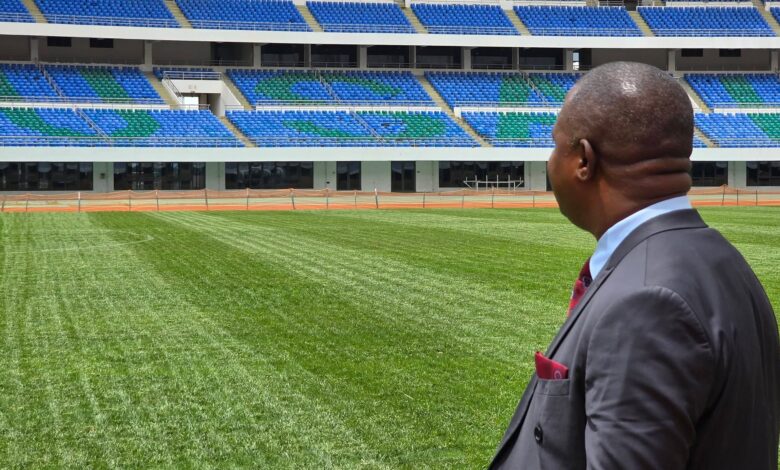
The first phase of the National Heroes Stadium rehabilitation project has been successfully completed with the installation of a modern hybrid football turf, a development that has left the Zambian Government highly satisfied with the quality of work.
During a press briefing at the stadium following an inspection, Minister of Youth, Sport and Arts, Hon. Elvis C. Nkandu, MP, described the new hybrid surface installed by Sporturf in partnership with European specialists GrassMax at a cost of approximately US$1.4 million as a significant milestone in restoring the facility to international standards, replacing the previous ordinary natural grass with a more durable option.
He emphasized that this achievement marks the start of a broader, phased rehabilitation programme aimed at tackling the stadium’s long-standing infrastructure challenges.
“Ladies and Gentlemen, we are here today to appreciate the progress made regarding Phase One of the project, which is the replacement of the ordinary turf with hybrid turf,” he said.
“It is important to undertake this on-the-spot inspection as it enables members of the press to present accurate information to the public on the progress of the rehabilitation project. You may wish to note that this project has been funded by the Government at a cost of 1.4 million United States dollars.
I am pleased to report that Phase One of the rehabilitation project the replacement of the ordinary turf with hybrid turf has been completed. The stitching was carried out by a European specialized company, GrassMax, which is a partner to Sporturf.”
He disclosed that repair works on two damaged roof panels are expected to commence soon, following the release of K2.6 million by Zambia State Insurance Corporation as part of an insurance claim.
He added that the government is pursuing additional upgrades, including the procurement of a turf protection system and installation of LED screen boards, while future phases will focus on the running track and perimeter fencing.
“Members of the press, as earlier indicated, the National Heroes Stadium also hosts non-sporting events and gatherings. Therefore, we are in the process of procuring a turf protector to prevent premature deterioration of the pitch. We are also engaging partners to support the procurement of electronic LED screen boards in order to align the facility with international standards.
Ladies and Gentlemen, you may also wish to note that two panels of the stadium roof are completely damaged. In addressing this challenge, our insurance provider, the Zambia State Insurance Corporation, conducted an assessment of the works required to replace the affected panels. I am pleased to inform you that the Corporation has handed over a cheque amounting to 2.6 million kwacha as an insurance claim for the damage sustained on the two roof panels,” Honorable Nkandu said.
“While we await additional funding to replace the entire roof, works to repair the damaged panels will commence as soon as the Ministry of Infrastructure, Housing and Urban Development finalizes the contract with a suitable contractor.
We are also looking forward to replacing the running track and erecting a perimeter fence in subsequent phases to help mitigate acts of vandalism.”
“Members of the press, allow me to conclude by informing you and through you, the nation that we are also seeking viable partners who may wish to invest in supporting facilities such as a shopping complex, shopping mall, hotel, fuel station, and other developments through the Public-Private Partnership (PPP) model. We have substantial undeveloped land available for such investments.
I am pleased to mention that we have already received one proposal to construct a shopping complex, and an advert was placed in the Times of Zambia and the Zambia Daily Mail inviting competing proposals,” he added.
The National Heroes Stadium was closed in 2024 after its playing surface and surrounding infrastructure deteriorated to what authorities described as a deplorable state, rendering it unfit for both domestic and international matches.
Once a flagship sporting facility, the stadium is one of only two CAF-certified venues in Zambia, alongside Levy Mwanawasa Stadium in Ndola.
According to the Ministry of Youth, Sport and Arts, the rehabilitation programme has included major works on the pitch, drainage system and other critical infrastructure required to meet Confederation of African Football (CAF) standards.
Officially opened in 2014, National Heroes Stadium was constructed at a cost of approximately US$94 million.
The project was financed through a loan from China and was designed to host major international sporting events and national celebrations.